
Remote access
Act without travelling, without opening a port
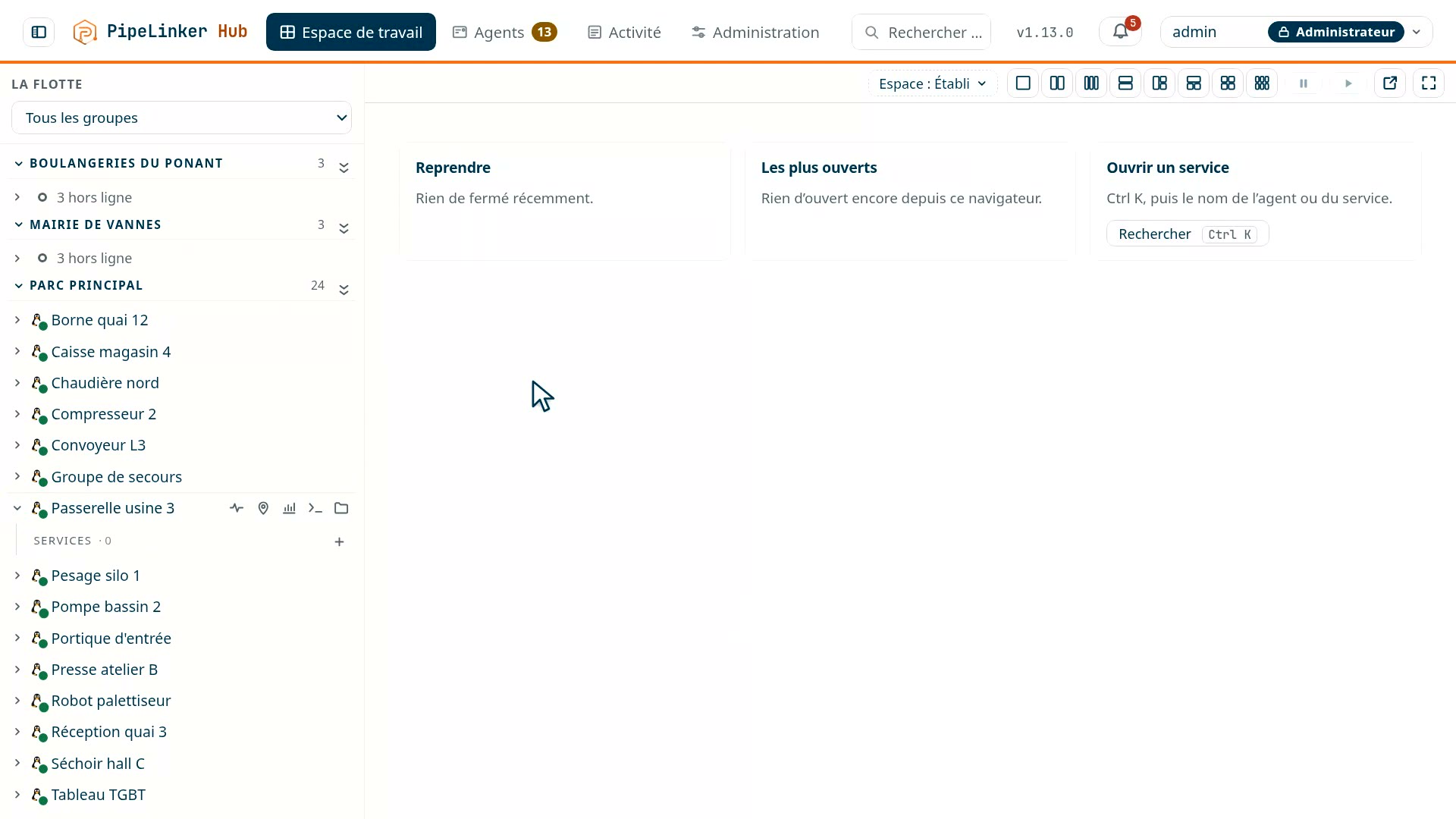
Your PLCs, HMIs, workstations and industrial equipment, reached without opening an inbound port. The agent calls the hub you host, and everything goes through that flow: terminal, files, remote screens and desktops, web interfaces, SNMP monitoring, cameras. One outbound flow to allow, no inbound rule. Before you open, telemetry says what answers; while you work, rights say who does what; afterwards, the log keeps it.
 Prise 2
No inbound port, ever
The agent itself establishes an outbound, encrypted connection to the hub, and keeps it open. Everything goes through it: telemetry, commands, updates, and remote access. So there is no firewall rule to obtain on the remote site, no fixed address to ask the carrier for, no port to expose on the internet.
A plain outbound internet connection is enough: a 4G or 5G link, a contractor's router, a site link - a network you do not control. The channel keeps itself up, and a whole fleet reconnects after an outage without bringing the hub down.
What you do through it
Through the agent, the hub opens SSH, Telnet, SFTP, FTP and FTPS, VNC, RDP, web interfaces, SNMP v2c and v3, RTSP and ONVIF cameras, and any declared TCP port. Each is described below, with what it does and where it stops, under the same rights and in the same log.
An interactive shell
A real session: line editing, completion, full-screen programs. On Linux as on Windows.
How the hub reaches the equipment behind the agent
Under each of these accesses, the same mechanism: it is the agent that opens the final connection to the requested host and port, always outbound. That is what gives you the machines behind it, and not only itself.
It is not one more feature, and there is nothing to do with it directly: you do not ask for "a tunnel", you ask for a declared service, and the tunnel is how it is reached. The hub knows no mode other than those above.
Nothing is installed on your workstation, and nothing listens there. The channel does not end in a local port: the right is granted to the person, not to the machine they happen to be sitting at. Every session - shell, files, screen, remote desktop, web interfaces - is held in the console, in the browser.
The files of the machine itself
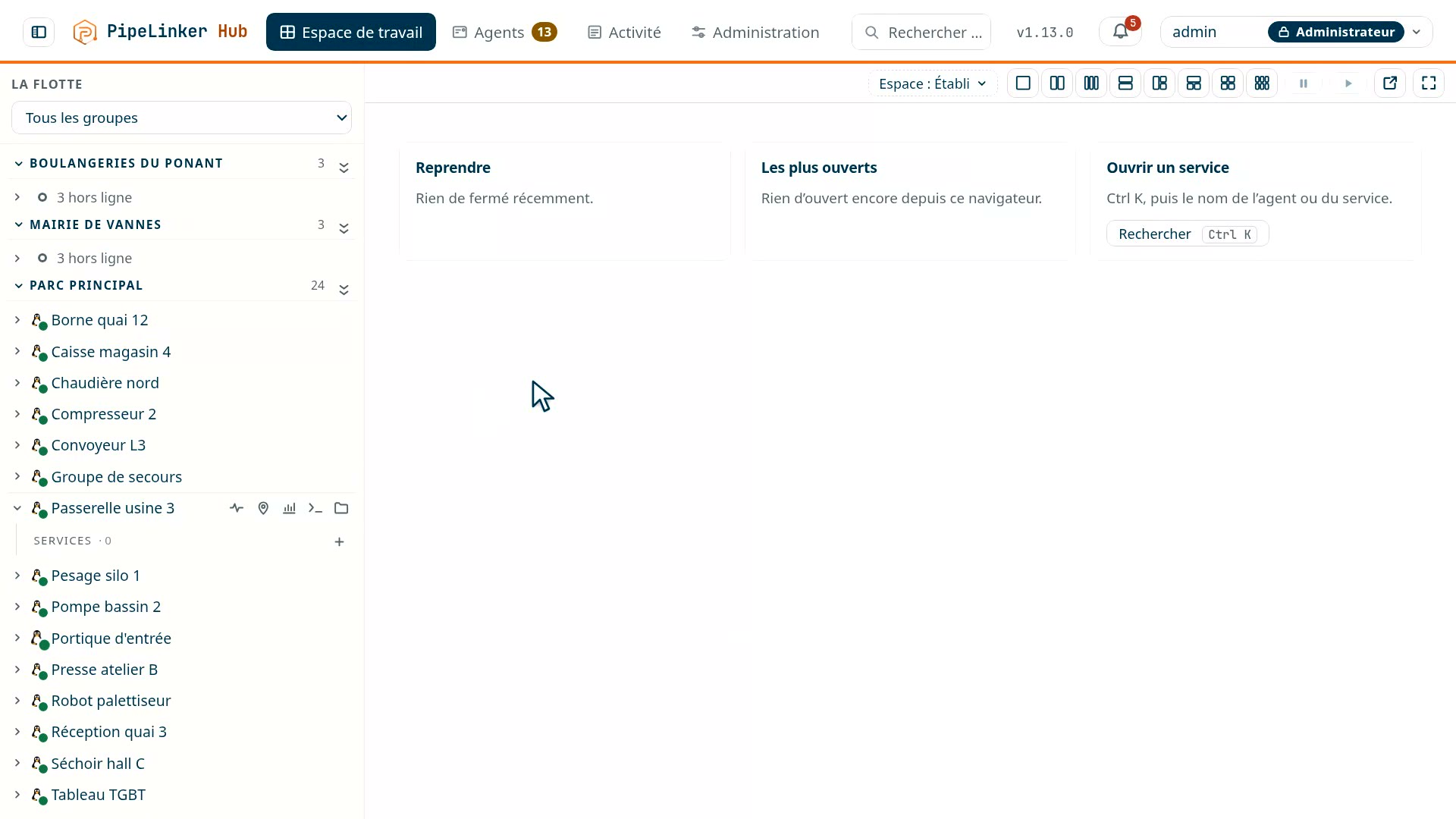
Distinct from SFTP: here there is neither SSH nor a declared service, the agent opens its own machine's disk, with its own rights. Browse, upload, retrieve, rename.
It is closed by default, and it takes two agreements to open it: the machine's and the operations team's - a control set on one side only would be worked around from the side you do not hold. The access is bounded by a declared root, and writing takes one more setting than reading.
Writes go into the log - upload, deletion, rename, permission change.
 Prise 8
SSH and Telnet, to a piece of equipment
A terminal opened on equipment behind the agent, in the console. Over SSH, the hub can hold the target's credential: the person intervening receives the right to open the session, not the password.
Telnet is there for the equipment that speaks nothing else, and it is called what it is: the trust badge marks it "in clear", and no policy can raise that level, since the protocol encrypts nothing. The hub holds no credential for it - the equipment's prompt asks for them - and the protocol's box is unticked by default on every machine. Both sessions are recorded and replayed; a Telnet recording keeps what was displayed, the password included if the equipment displayed it.
The files of a piece of equipment
An SFTP, FTP or FTPS server behind the agent opens in the same file browser as the machine itself: the hub speaks the protocol behind it. Every upload, rename or deletion goes into the log.
FTPS is a TLS policy set on the service, and the badge says which of the two you are opening. What is not served: active mode, which would ask the equipment to connect outwards, and implicit FTPS on port 990. The agent opens the data channel only on the range the server announces.
A remote screen
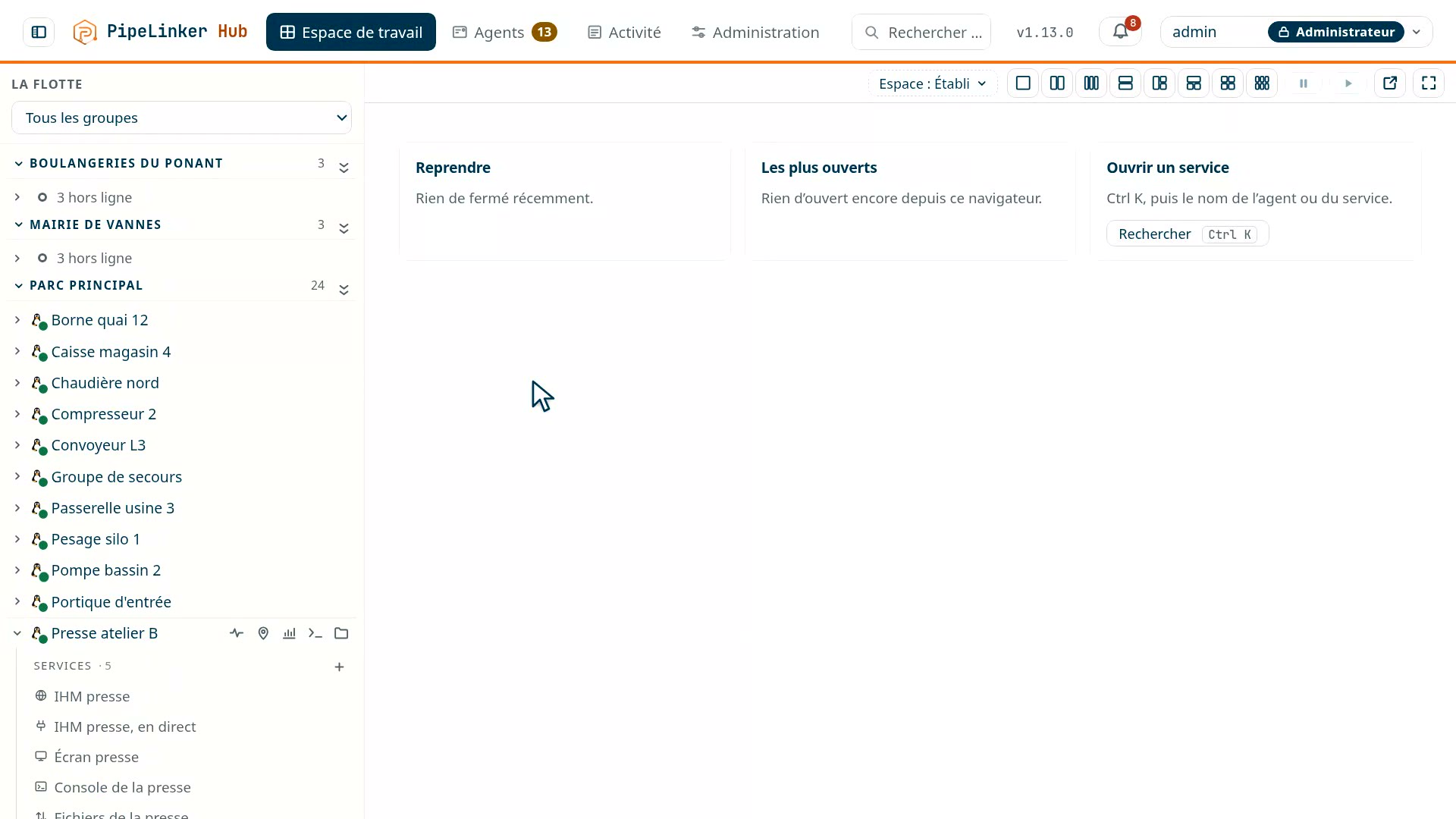
Access to a VNC server local to the agent, or simply reachable from it: the same mechanism, the agent opening a connection to the requested host and port. Nothing to install on the target machine.
 Prise 7
A remote desktop
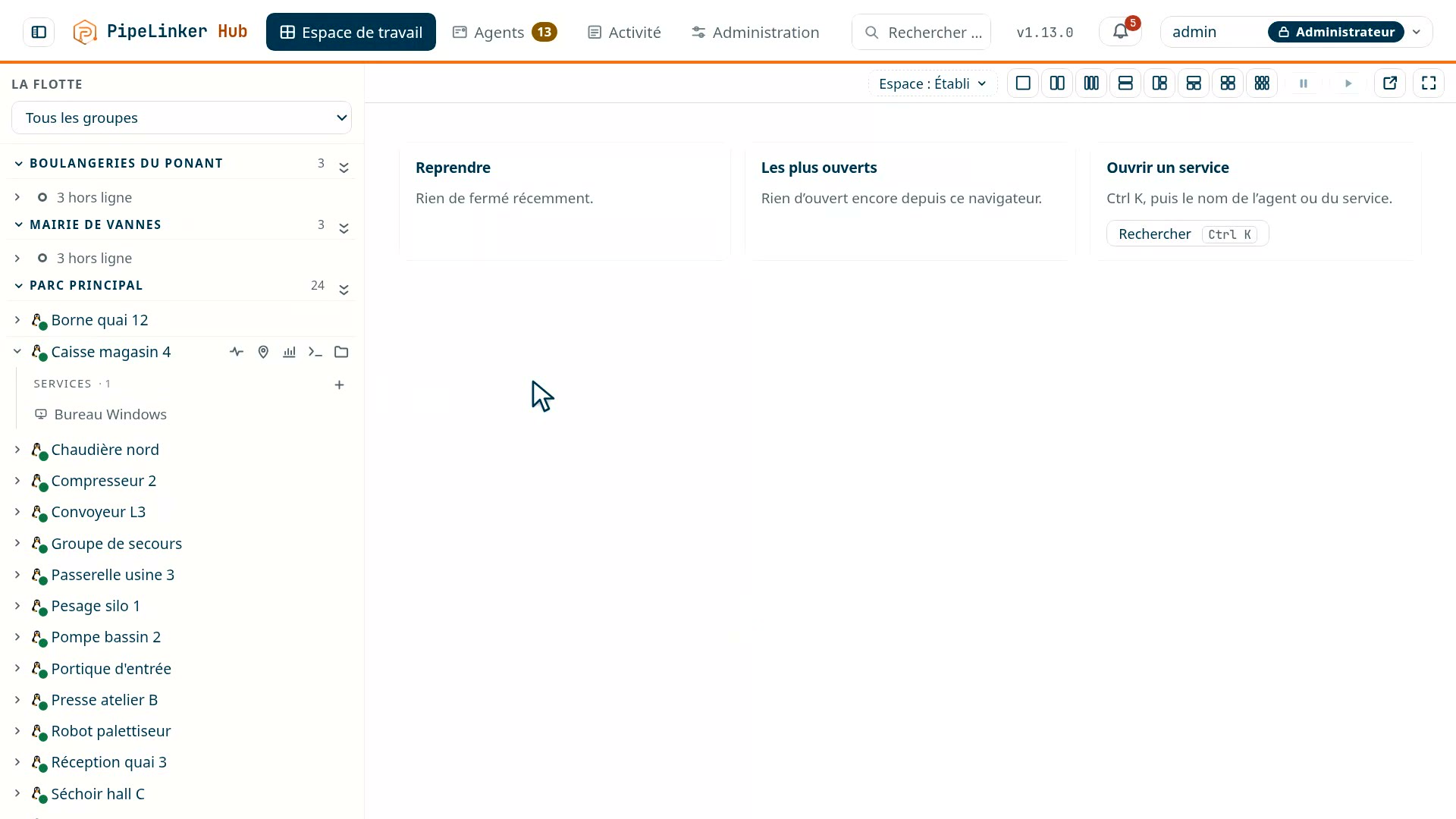
A Windows workstation reachable behind the agent opens in one of two ways, chosen by whoever declares it, and the desktop's card says which.
Supervised: the hub opens the session itself, with the service's saved account, and decodes it. That is what makes it possible to record it and to hand it over read-only - someone watching without being able to act. It opens in the browser, with no client to install, or in the workstation's RDP client - mstsc, FreeRDP, Remmina -, which then receives the image the hub decoded and is recorded the same way. The workstation's drives, printers and sound do not go through.
Relayed: the hub only carries bytes, to the browser or to the workstation's client. Nothing is recorded, nothing is handed over read-only, and no password is kept: it is RDP as it is, for whoever wants it that way, and the console says so on the desktop's card.
 Prise 13
Equipment web interfaces
The web HMI of a PLC or a UPS, opened in your browser through the agent's connection.
Reading and monitoring equipment over SNMP
The hub queries a switch, a UPS or a PLC itself: its sheet - name, location, uptime, its interfaces, their state and throughput -, any identifier, and the ones you choose to monitor, polled at an interval, kept for a month, with a threshold that warns when it is crossed and when the value comes back.
v2c by community, v3 by user, at all three security levels; the community and the keys are sealed in the hub and never leave it. The badge says what crosses the site's network: only encrypted v3 is encrypted. Read-only: the hub never writes to equipment and receives no traps. The agent relays UDP datagrams it does not read, within the same perimeter as a TCP connection - the Android agent too, for equipment only the phone can reach. Reading equipment takes a right of its own, distinct from the right to see the declared service.
A camera, in the console
An RTSP camera opens in a workspace tab, on the single declared port, over RTSPS when a TLS policy asks for it. One connection to the camera, however many people are watching, and each of them goes into the log.
With an ONVIF port declared as well, a "Controls" button gives what the camera offers: a snapshot, pan, tilt and zoom for as long as you press, presets, the infrared filter, focus. The hub stops the camera as soon as the orders stop arriving - it never keeps turning because a message was lost. Controlling takes one more right than watching.
What does not play: the browser plays H.264 only. A camera in H.265, MJPEG or MPEG-4 says so instead of showing a black rectangle - the hub does not re-encode. Sound is not played.
Any other TCP port
What belongs to none of the families above is declared as a port: its address, its number, and it becomes reachable through the agent, with the same rights and the same trace. With PipeLinker Desktop, your own tools reach it - a PLC client, a database client - through a local port on your workstation.
Tell us what equipment, behind which networks. We show you the console on it.
Traced, recorded, defensible
 Prise 3
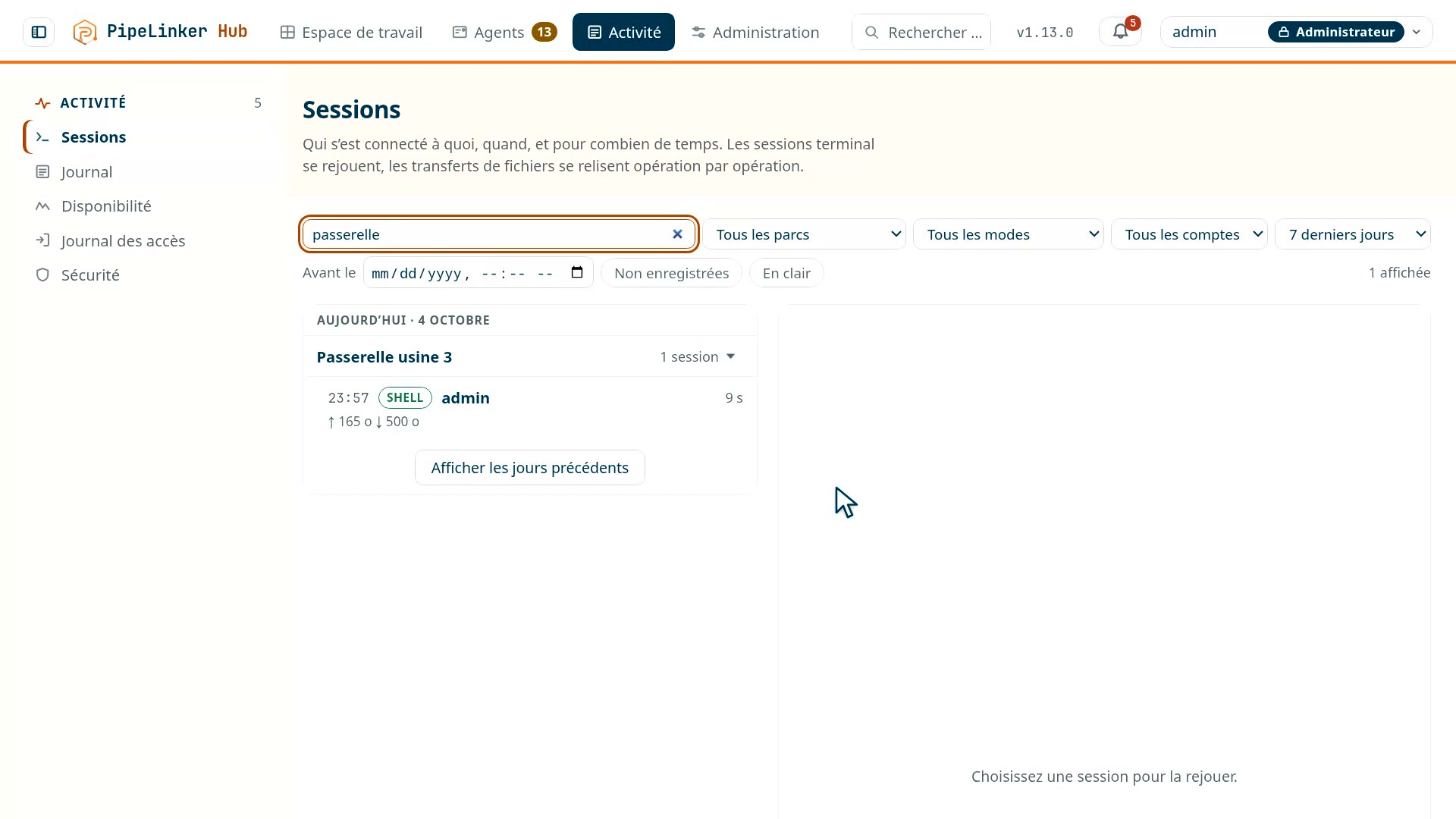
The audit log keeps who accessed what, when, and what was done there; terminal and screen sessions are recorded and replayed. You do not only open the door: you can show what happened behind it.
A session in progress can be watched too, from the console, by someone else who can send nothing - neither mouse nor keyboard. Terminal, screen or desktop, the person being watched knows it: a banner tells them. From the machine's "Sessions" tab, whoever holds the right can also cut it.
Recordings have a retention period and a maximum size, which you set; the purge never removes a session still being written. Every morning, a report tells the administrators the space used, what was added and what the purge removed, fleet by fleet.
The interactive shell remains an advanced capability, kept for the roles that warrant it: not everyone needs a command prompt on a gateway in production.
What you know before opening the session
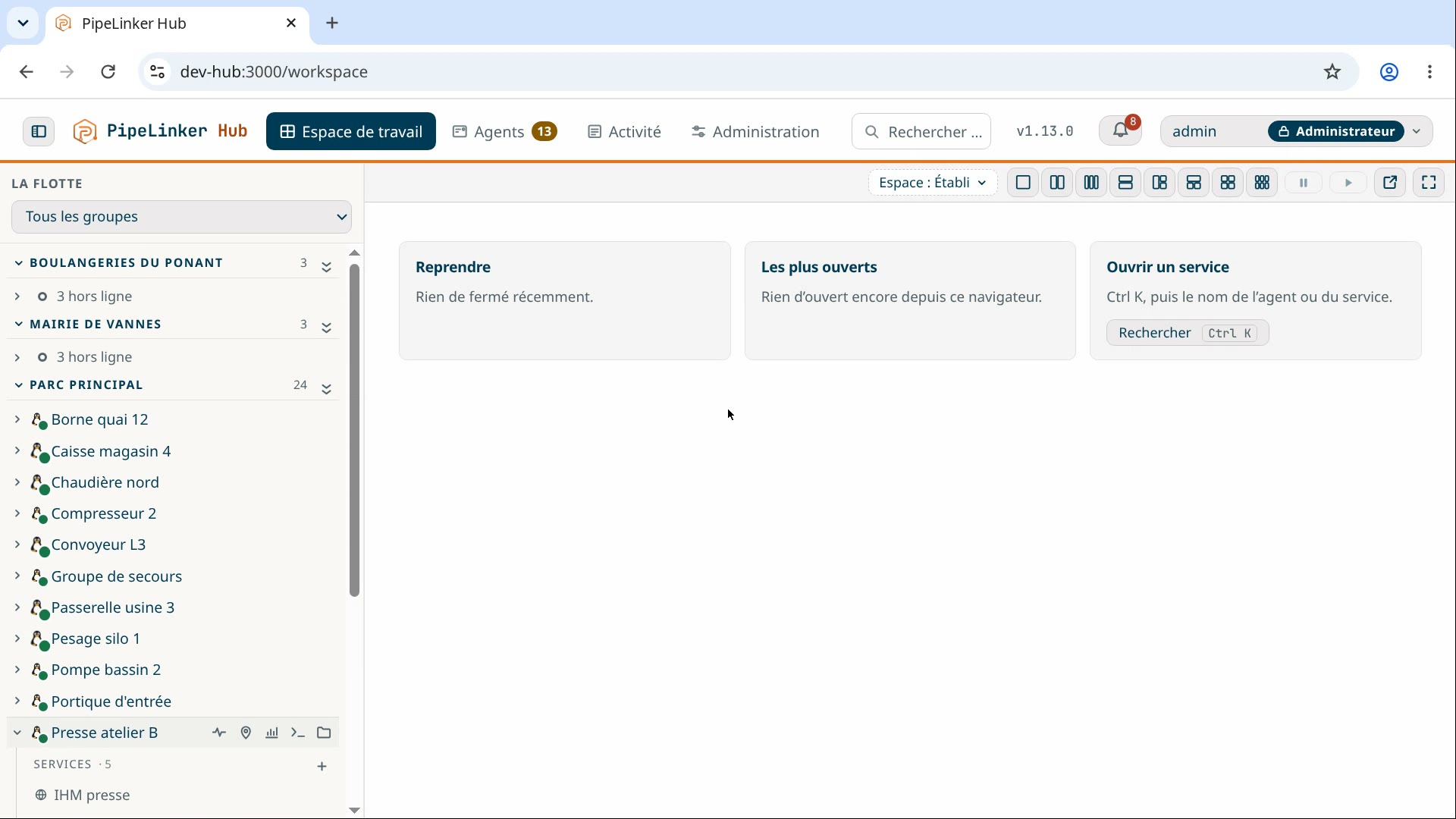
The agent reports the machine's telemetry and metrics without being asked: what answers, what no longer answers, since when, and what runs on it. So you know what to open - and sometimes that there is nothing to open: a machine unreachable for three days is not a session to open, it is a trip to plan.
A PLC's HMI, in your browser
 Prise 4
What is particular about this equipment
A PLC, a UPS, a camera, a line HMI: most of this equipment exposes a web interface, and that interface is the only serious way to configure it. It lives on a network you cannot reach from your desk, behind a remote site with no inbound port open.
The usual answers are expensive: a VPN per site, a jump host to maintain, or a trip.
Web interfaces that work as they do on site
This is the choice that decides reliability. Routing by path prefix breaks the absolute URLs these firmwares write everywhere; routing by hostname leaves them intact.
A corollary: response bodies are never rewritten. The page arrives as the equipment produced it, which no rewriting can guarantee.
And two pieces of equipment do not step on each other: each has its own origin, and therefore its own cookies.
A domain distinct from the console's
This is not cosmetic: on a subdomain of the console, the web interface of a compromised piece of equipment could set a cookie that reaches the console itself.
The session cookie carries the __Host- prefix: the isolation is
checked by the browser rather than promised by us.
What goes through
TLS all the way to the equipment, including to the self-signed certificates most firmwares carry. The WebSocket upgrade, which modern HMIs depend on to refresh their values live. And authentication by the hub upstream: the equipment is only reachable once the hub has recognised the person and checked their rights, the session being traced like the rest.
What does not go through
Equipment that requires NTLM or Negotiate will not open this way: both mechanisms assume a TCP connection held end to end.
The failure is plain: what works will always work, what does not go through never will. You find out at enrolment, not on the day of an intervention.
On Android, within the system's limits
The Android agent carries the terminal, the files and the tunnels, but within what Android leaves to a non-rooted application: the terminal runs under the agent's own identity, in its sandbox, and the files are the folders the device has granted. It does not serve its own screen - that is a permission the agent does not ask for - but the screen of equipment behind it is reached through the tunnel, as from any other agent. It relays UDP too, and so SNMP. What the Android agent does